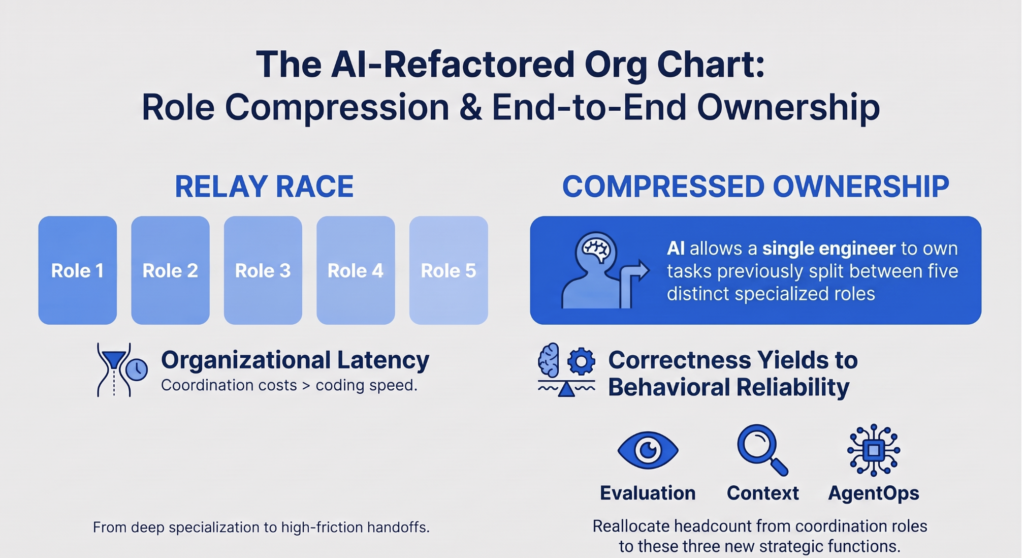
Most CTOs have accepted that AI changes how software gets built. Far fewer have confronted the secondary wave: AI is about to refactor the engineering org chart.
For two years, enterprise AI adoption has focused on local developer productivity: faster cycle times, higher ticket throughput, and automated code generation. These metrics target the wrong layer. Measuring how fast an engineer types ignores the larger structural bottleneck: organizational latency.
Focusing solely on local developer productivity avoids a harder conversation: which roles on your team still need to exist as separate, dedicated jobs?
The Legacy Model: Built for Human Cognitive Limits
For thirty years, software organizations operated as specialized relay races.
Business Analyst ➔ Product Manager ➔ System Architect ➔ Software Engineer ➔ QA Engineer ➔ DevOps/SRE
A business analyst translated market pain into requirements. A product manager prioritized them. An architect mapped the system. Engineers built code. QA tested edge cases. DevOps deployed. SRE monitored. Each function carried the baton for one leg of the journey before handing it off.
This division of labor was necessary. Complex software architectures easily exceeded the cognitive capacity of any single human. An entire organizational operating system grew around these boundaries: specialized career ladders, compensation bands, delivery frameworks, and headcount formulas.
AI alters the fundamental constraint behind that design.
An AI-enabled engineer can now move autonomously from ambiguous intent to spec, from spec to system architecture, from architecture to implementation, and from code to automated test suites.
This creates Role Compression. It does not mean specialized functions disappear entirely. It means something far more radical: work that previously demanded five distinct roles can now be owned end-to-end by a single high-leverage engineer.
| Metric / Dimension | The Legacy “Relay” SDLC | The AI-Native Operating Model |
|---|---|---|
| Primary Bottleneck | Execution & Coding Speed | Organizational Latency & Coordination |
| Org Structure | Deep Functional Specialists | Compressed End-to-End Owners |
| Core Value Metric | Output Volume & Ticket Velocity | Behavioral Reliability & System Leverage |
| Hand-Off Cost | High (Days spent in queues) | Near Zero (AI-assisted context synthesis) |
When implementation time drops from days to minutes, the relative cost of organizational coordination skyrockets. A three-day requirements process cannot survive when a working prototype takes three hours. A ticket sitting idle in another team’s queue for forty-eight hours is no longer standard operating procedure—it is an existential tax on innovation.
The Operational Pivot: From Code Correctness to Behavioral Reliability
Role compression is only half the equation. While traditional engineering tasks compress, an entirely new operating lifecycle is expanding alongside it—one that most enterprises are severely underfunding.
Traditional software relies on predictable logic: you write code, review it, test it, and deploy it. AI-driven systems behave differently. System output depends on underlying models, dynamic prompt context, available tools, runtime permissions, and evolving evaluation tests.
Determinism (Code Correctness) ➔ Non-Determinism (Behavioral Reliability)
We are transitioning from an SDLC optimized for code correctness to an operating model built for behavioral reliability. Managing this transition requires four new strategic functions that standard org charts fail to reflect:
1. Evaluation Engineering
In an agentic environment, the evaluation suite is the specification. Evaluation engineers do not ask whether a piece of code matches a fixed design. They define what “good” looks like across stochastic outputs, construct gold-standard benchmark datasets, establish grading rubrics, and run continuous regression testing against dynamic models.
2. Context Architecture
Base models are fast becoming a commodity, but dynamic context is not. Context Architects control what an AI layer can see, retrieve, call, and remember at any given millisecond. Most enterprise AI failures stem from context problems caused by fragmented data, not model limitations.
3. AI Product Intent
Standard product management focuses on backlog prioritization. AI Product Intent focuses on boundary design for non-deterministic behavior. This role defines how the system handles ambiguity, when it should request human-in-the-loop validation, where its refusal boundaries lie, and how it fails gracefully.
4. Agentic Operations (AgentOps)
Traditional SRE keeps infrastructure online. AgentOps monitors autonomous reasoning paths, tool-invocation chains, token unit economics, drift, and blast radius. As AI systems shift from answering questions to executing multi-step autonomous actions, observability must shift from system uptime to action accuracy.
Reallocating the Talent Portfolio
The central question facing engineering leadership is no longer “How many developers can AI replace?” It is “Where must human judgment sit when AI handles execution?”
Navigating this transition requires practical structural changes:
- Redesign Career Ladders: Stop rewarding deep single-station specialization. Start incentivizing systemic ownership, evaluation rigor, and leverage per person.
- Collapse Coordination Layers: Restructure teams around end-to-end problem domains rather than functional hand-off stages.
- Shift Headcount Budget: Shift real capital away from traditional coordination roles and directly into Evaluation Engineering, Context Architecture, and AgentOps before operational risk forces your hand.
Companies that settle for incremental gains, like giving developers a coding assistant while keeping the traditional handover process intact, will soon be outpaced by competitors who redesign their teams around role compression.
Keep growing!
Gunjan