To the technology and product leaders who spent this year putting AI into the hands of builders, the work you did was real. Moving people onto new tools while keeping delivery commitments intact deserves recognition. The next challenge is making sure faster execution has a direction worth following.
If your team can build a feature in two days but needs three weeks to agree on what it should do, coding speed is no longer the only constraint. Decision latency belongs on your dashboard.
Faster building exposes the direction problem
In his November 22 conversation with Lenny Rachitsky, Atlassian’s Sherif Mansour described an experiment with teams where PMs and designers became AI builders. After an early burst of speed, people returned to their traditional responsibilities. One PM’s explanation was direct: “Throughput’s not our problem. Direction’s our problem.”
I hear that as a challenge to one influential AI narrative: give everyone the tools, collapse the roles, and let velocity do the rest. Access to execution does not eliminate the need for product judgment.
The operating question I keep coming back to is what our delivery metrics leave invisible. A pull request has timestamps. An unresolved disagreement about which customer problem matters can sit across meetings and chat threads without anyone measuring its cost.
What the benchmark actually tells us
The SWE-CoWork research preprint examines a related problem. It gives coding agents 101 assignments across 101 real repositories, placing each agent in a simulated organization with 26 colleagues. Requirements are distributed across people and workplace records.
The two leading models passed approximately 63% of tests for the requested new behavior but completed fewer than 8% of assignments. Complete requirements improved partial test performance for two models by about 16 percentage points without improving complete task success. Failures continued through implementation and verification.
This is a simulated benchmark, not an enterprise productivity study. It reveals a gap between partial implementation and completing an assignment. My inference is that clearer direction helps, but reliable delivery also requires teams to carry requirements through execution and verify the result.
Measure decision latency alongside delivery speed
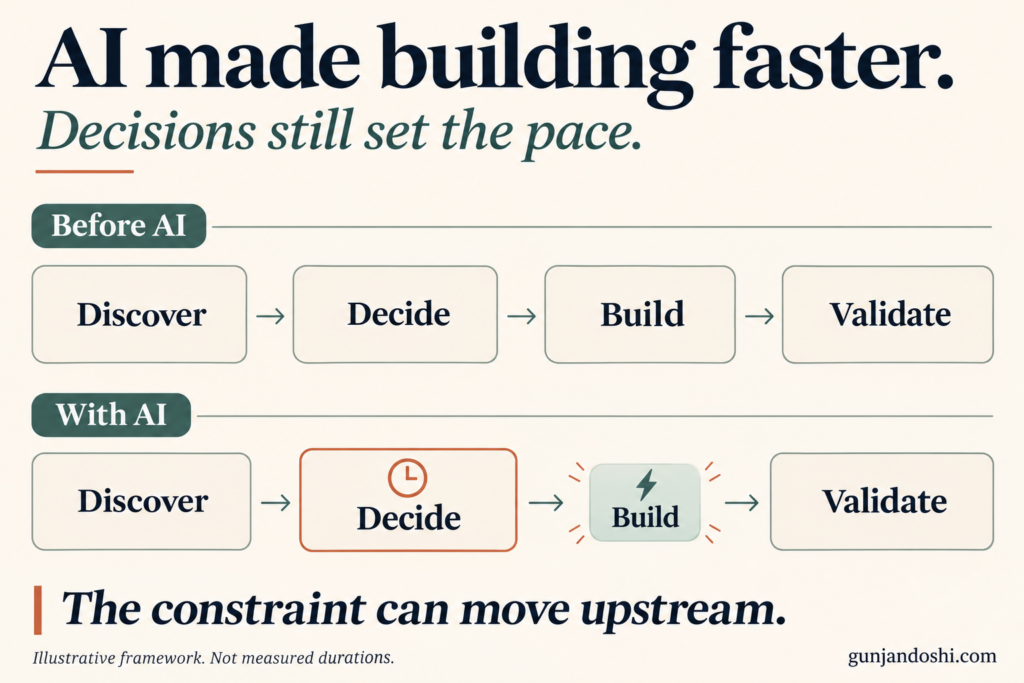
In an AI-enabled product development lifecycle, or PDLC, the constraint can move upstream. That will not happen equally in every team. Integration and production validation can still dominate delivery time. Leaders need to measure where their own work waits.
Start with one product workflow. Record when a customer signal becomes ready for a decision, when an accountable owner makes that decision, and when work begins. Separate active investigation from time spent waiting for someone to resolve a conflict.
Pair elapsed time with quality. Track work reopened because a requirement was misunderstood, decisions reversed when missing evidence surfaced, and whether the shipped change improved the intended customer outcome. Faster decisions without those checks can simply move waste downstream.
Give agents a decision record they can work from
Consider a hypothetical team building a customer onboarding change. Engineering believes the goal is fewer screens. Operations needs an exception path. Compliance requires evidence that a check occurred. An agent can generate a shorter flow quickly and still deliver the wrong result.
Before building, give that team a short decision record:
- Name the customer problem, the intended outcome, and the person accountable for resolving trade-offs.
- List conflicting requirements and their owners. Mark unresolved questions explicitly instead of burying them in a ticket.
- Write acceptance criteria that cover the normal path and the exception path, including the evidence needed for audit.
- Record the decision and its reasoning, then connect each requirement to an implementation check and a verification result.
The record does not need to become another approval ceremony. Keep it close to the work, update it when evidence changes, and let a prototype answer questions that are cheap to test. Escalate ambiguity when getting it wrong would create a costly or difficult-to-reverse commitment.
AI can make some mistakes cheaper to discover through prototypes. It can also multiply downstream waste when teams scale an untested assumption into production. The difference is whether learning happens before commitment.
Train judgment where the work begins
Most enterprise AI academies I have reviewed focus on tool use. That was a reasonable first chapter. The next chapter should give experienced people practice questioning the requirements they are about to execute.
Have engineers identify the assumption a specification leaves unstated. Have PMs write requirements a human can audit as well as an agent can act on. Let designers prototype during the conversation so the team can examine a decision before turning it into a delivery commitment.
Keep product and design leaders close to execution. Their contribution becomes easier to see when the organization measures whether teams understand the problem and can verify that they solved it.
The pattern I trust is that the constraint moves. Our job as leaders is to notice where the work is waiting and give people the authority and evidence to move it forward.
Let me challenge you, and please challenge me back: in your AI PDLC today, is the longer wait for working software, or for a decision the team can confidently build against?
Keep growing.