Six engineers rebuilt the Amazon Bedrock inference engine in 76 days, on a job that had been scoped at 40 engineers and a year, and Andy Jassy liked that number enough to put it in his own shareholder letter. When a CEO puts a number in a shareholder letter, he wants it to travel, and this one has.
It is also the number AWS is using to sell the industry a new vocabulary. The two-week sprint is being replaced by something they call a Bolt, a unit of work sized in hours, sitting inside a three-stage loop of Inception, Construction, and Operation. Epics become Units of Work. Grooming becomes Mob Elaboration.
I have no argument with the diagnosis underneath any of this. My argument is with what people think the rename fixes.
Where AWS is right
The two-week sprint existed for one reason, which is that humans write code and humans are slow relative to two weeks. Once you hand a unit of work to an agent that can draft the design, build the domain model, and ship working code in an afternoon, the sprint stops being a rhythm and turns into dead time, with half of it spent waiting on ceremonies sized for a pace nobody is working at anymore.
So the instinct to shrink the unit is the right one. The question stops being what can we finish in two weeks and becomes what is the smallest slice of work a human and an agent can carry from idea to validated output in one sitting. Almost every engineering team I have sat with this year is circling that exact question, whether or not they have ever heard the word Bolt, and AWS is right that the shape of the work has to change before anyone’s calendar around it means anything.
Where the story goes quiet
The part nobody is saying out loud is that the bottleneck in 2026 was never how fast code gets written. It is how fast code gets trusted.
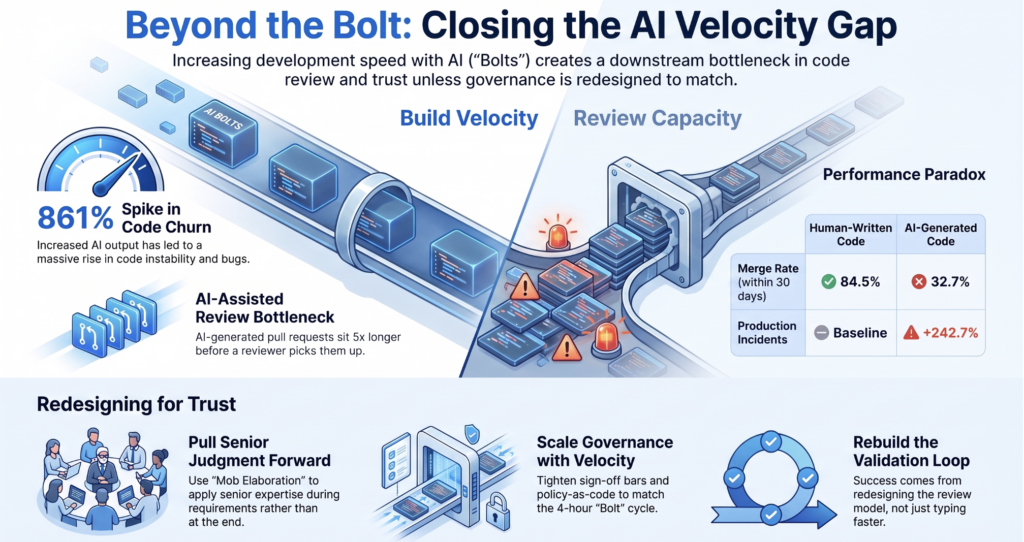
LinearB looked at 8.1 million pull requests across 4,800 teams in 42 countries and found that AI-assisted pull requests now sit roughly five times longer before a reviewer even picks them up, they are 2.6 times larger, and only 32.7 percent of them merge within 30 days, against 84.5 percent for human-written code.
Faros AI came at the same question with two years of telemetry from 22,000 developers on more than 4,000 teams and found code churn up 861 percent, bugs per developer up 54 percent, production incidents per pull request up 242.7 percent, and the share of developers merging AI-generated code without touching it climbing from one in five to three in five in a single year.
Put those two studies next to each other and the story tells itself. Output went up and every downstream signal got worse, faster. The review bottleneck did not disappear when the unit of work got smaller, it moved downstream and got heavier, because compressing how fast code gets built without redesigning how fast it gets validated just means the organization manufactures review debt on a faster clock. A Bolt that ships in four hours and then sits untouched in a queue for three days is the same delay the sprint had, wearing a new name, and your dashboard will still report it as plain old cycle time.
The fix has to move at the same speed as the unit
Mob Elaboration deserves real credit here, because it pulls senior judgment forward into requirements instead of parking it at the end in code review. The catch, which AWS’s own financial services documentation admits, is that it only holds if the same senior people show up to every Bolt cycle rather than the first one. Skip that discipline once and the whole advantage folds back into the bottleneck it was supposed to remove.
There is a second thing worth noticing. The governance AWS actually built for regulated industries, the steering files that encode security policy and the requirement-to-production traceability, mostly lives in the finance-specific version of the playbook. The version of AI-DLC most engineering blogs are excited about right now is almost entirely about the Bolt, and the governance layer that makes a four-hour Bolt as trustworthy as a two-week sprint used to be is a separate and harder problem that most teams have not started.
I do not think this is an AWS story at all. GitLab and TCS rolled out their own version of the same fix this year under the name Intelligent Orchestration, built on policy-as-code governance and standardized golden paths where every agent action carries full project context and gets logged as auditable before it can merge. Different vendor, same diagnosis, and a cure with the same shape.
That convergence is the real signal. Whoever’s logo is on the platform, the unit of work has to shrink, and I consider that settled. Shrinking it only pays off if the governance wrapped around each unit, meaning who signs off, when, and against what bar, tightens at the same rate. Get the unit size right and leave the review model alone and what you have built is a faster way to accumulate the risk you already had.
What this looked like on one engagement
This has been the operating premise behind every AI-DLC engagement we have run this year. At a leading financial institution I cannot name yet, that discipline was the entire difference between a team that cut nine engineers while tripling output and a team that would have shipped three times the defects at the same new speed. Same methodology, same Bolt structure, same tooling, and the only variable was whether governance scaled with the unit of work or got left behind at the old two-week pace.
A Bolt is a good unit of measure. Whether it is a good unit of trust depends entirely on what you build around it, and that is worth doing on purpose rather than inheriting by default from whoever coined the term.
What I would ask before adopting this
Forget how small the unit of work can get and ask these instead. Where does your review capacity sit against your build velocity, and can you back that up with a number or only a feeling? Who actually shows up to every Bolt cycle and not only the kickoff, and what happens to your defect rate the week they do not? What gets logged automatically the moment an agent’s work merges, and would that log hold up in front of an auditor six months from now? Was your validation model rebuilt for this pace, or is it still quietly assuming the two-week review cycle it was designed around a decade ago?
Smaller units and faster cycles are real and worth taking seriously. Just do not confuse the rename for the redesign. Six engineers did not rebuild Bedrock in 76 days because they typed faster than forty people would have. They did it because the validation loop around them was rebuilt to match the new pace of the work, and that is the part of the story worth stealing. The vocabulary was always the easy part.
Let me challenge you: which of those four questions can your team answer with a number today?
Keep growing!
Gunjan