The Future engineering is not typing faster, the future engineering is deciding better.
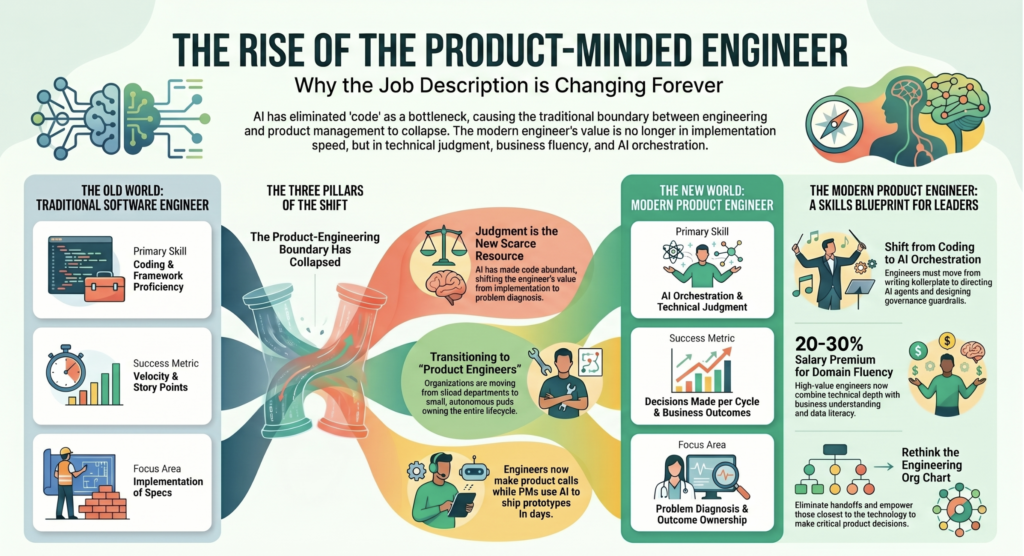
The title “Software Engineer” is becoming a relic.
Not because engineers are less important. Because the job has fundamentally changed — and most organizations haven’t caught up.
Here’s what I mean.
I spend my weeks inside some of the largest firms in the world. And the pattern I keep seeing is the same everywhere:
The best engineers are increasingly writing less code. They’re making more decisions.
Product decisions. Architecture decisions. Business decisions. The kind of calls that used to sit two levels above them in the org chart. And they’re doing it faster than anyone expected — because AI eliminated the bottleneck that kept them in their lane.
Code was the bottleneck. Code kept engineers heads-down for weeks. Code was the reason you needed product managers to prioritize, designers to spec, and project managers to sequence.
When AI writes the code, all those coordination mechanisms — the PRDs, the backlog grooming, the sprint planning, the handoff rituals — become the slowest part of the system.
The engineer who can decide AND build is now faster than the team that decides by committee and builds by handoff.
That’s not an efficiency gain. That’s a structural collapse.
What Actually Changed
Three things happened simultaneously, and the compound effect is what nobody saw coming:
First, AI didn’t just speed up coding. It eliminated code as the scarce resource.
When Anthropic’s own engineering teams describe how they use Claude Code, the shift is revealing. Engineers are no longer spending their time writing boilerplate or gathering context. They’re acting as “thought partners” with AI — focusing on which problems to solve, not how to implement them. Their security team went from weeks-long diagnostic cycles to resolving production issues 3x faster — not by writing better code, but by asking better questions.
That’s the shift. The scarce resource used to be implementation capacity. Now it’s judgment.
Second, the boundary between “product” and “engineering” didn’t blur — it collapsed.
VentureBeat recently ran a piece titled “When Product Managers Ship Code, AI Just Broke the Software Org Chart.” The headline sounds provocative. It’s actually conservative. What’s happening is more radical: PMs are building prototypes with AI tools and shipping them to production in a day. Engineers are making product decisions because they’re the ones with the context — they see the data, they see the edge cases, they see what’s actually possible. The old model where product decides WHAT to build and engineering decides HOW — that clean separation is gone.
OpenAI runs with a deliberately lean product management team because they want engineers to absorb product responsibility by design. That’s not a cost-cutting move. That’s a belief about what the job actually is.
Third, the market started naming the new role.
A recent analysis of 50+ job postings found that “Product Engineer” is replacing “Software Engineer” as the dominant title — not as a rebrand, but as a fundamentally different job description. Companies are moving away from massive, siloed teams toward small, cross-functional pods where engineers own the entire lifecycle from discovery to deployment. Seniority is no longer measured by years of experience but by the ability to provide clarity when things get messy.
At the Pragmatic Engineer Summit this year, the headline finding was that role blurring is now the dominant pattern: designers are coding, PMs are prototyping, and engineers are orchestrating AI agents. The old title doesn’t describe the job anymore.
Why This Matters to CIOs and CTOs — Right Now
If you lead a technology organization, here’s what this shift demands:
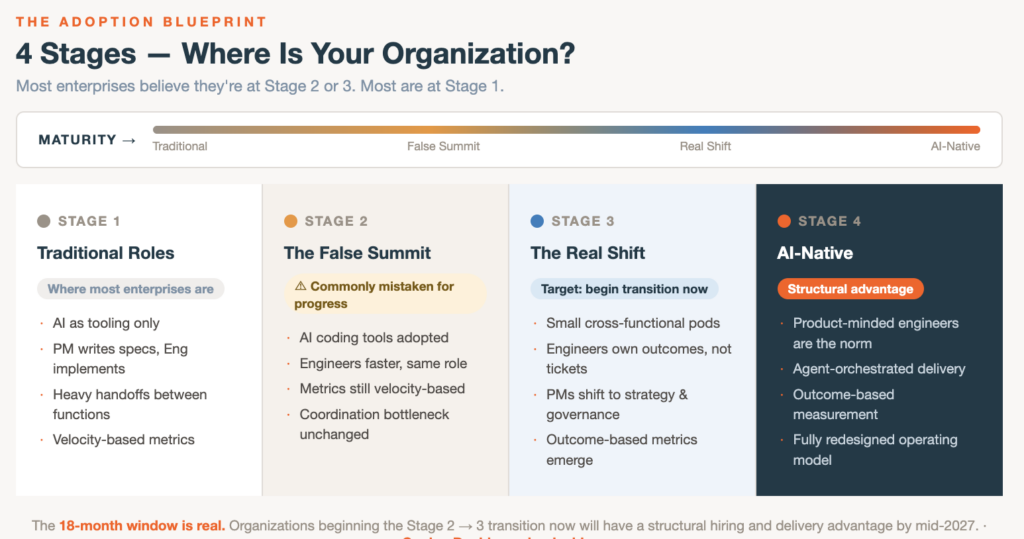
Rethink your org chart. The product-engineering-design triad that defined software teams for 20 years is breaking down. The teams that ship fastest in 2026 are small pods of product-minded engineers with direct business access and AI tools that handle implementation. If you’re still hiring “software engineers” into a structure where they sit three handoffs away from the customer, you’re building the wrong organization.
Rethink your hiring criteria. The premium skill is no longer coding proficiency. Engineers who combine technical judgment with business understanding and data fluency command 20-30% salary premiums — and they’re worth it. When you interview, stop testing for algorithm knowledge and start testing for product instinct: can this person identify the right problem, make a tradeoff decision, and explain why to a non-technical stakeholder?
Rethink your PM function. This isn’t about eliminating product managers. It’s about redeploying them. When engineers absorb product decisions at the feature level, PMs become most valuable at the strategy level: portfolio prioritization, market sensing, customer insight synthesis, and governance. If your PMs are still writing user stories and grooming backlogs, you’re wasting your most strategic thinkers on coordination work that AI just made obsolete.
Rethink how you measure engineers. Lines of code, story points, velocity — these metrics measured the old job. The new job demands new metrics: decisions made per cycle, time from insight to deployment, business outcomes delivered per pod, and the quality of the judgment calls embedded in the systems they build.
Rethink your training investment. Your engineers need product thinking skills, AI orchestration skills, and business domain fluency — not another JavaScript framework course. The organizations investing in this reskilling now will have a structural advantage in 18 months. The ones that wait will be trying to hire their way out of a gap that the entire market is competing for.
The Skills Blueprint: What Your Engineers Need to Become
If you’re a CIO reading this and thinking “okay, but what do I actually DO” — here’s the map.
I’ve spent the last two years watching what separates the engineers who thrive in this new world from the ones who get stuck. It comes down to five capability shifts:
1. Core Craft: From Coding Proficiency → AI Orchestration The old job was mastering languages and frameworks. The new job is directing AI agents, evaluating their output, and designing the systems that connect human judgment to machine execution. Code review becomes AI output evaluation. Algorithm design becomes systems architecture — not for software, but for human-AI systems with governance guardrails.
2. Product & Business Thinking: From Spec Implementation → Problem Diagnosis The old job was building what the PRD said. The new job is identifying the right problem before building anything. Backlog execution becomes tradeoff reasoning — prioritizing by impact, making build/buy/agent decisions, defending choices with data. Feature delivery becomes outcome ownership — you own the business metric, not the ticket.
3. Communication & Influence: From Technical Docs → Stakeholder Translation The old job was writing docs for other engineers. The new job is explaining tradeoffs to non-technical leaders and influencing business decisions. Stand-up updates become decision framing — presenting options with risk/reward, recommending a path, getting buy-in fast. This is the most underinvested skill in most engineering orgs and it’s now table stakes.
4. Governance & Judgment: From Testing → Guardrail Design The old job was writing tests for correctness. The new job is defining what agents can and can’t do autonomously — building the safety boundaries for AI systems that make real decisions. Security expertise evolves into AI risk assessment: hallucination risk, data leakage, regulatory exposure, autonomy boundaries. For financial services, this is where careers are made or broken.
5. Data & Domain Fluency: From Framework Expertise → Business Domain Mastery The old job was deep knowledge of React or Spring or Django. The new job is understanding the business deeply enough to build intelligent systems for it — compliance, risk, operations, customer journey. Engineers who combine technical judgment with domain fluency and data literacy command 20-30% salary premiums. And they’re worth every dollar.
The CIO Question That Changes Everything
Here’s the question I’d ask every CIO reading this:
What percentage of the product decisions in your organization are currently made by engineers?
If the answer is low, you have a structural problem. You’ve built an organization where the people closest to the technology — the people who see what’s possible, what’s breaking, and what the data says — are not empowered to make the calls that matter.
If the answer is high but unstructured, you have a governance problem. Engineers are making product decisions by default because the coordination mechanisms are too slow — but there’s no framework for which decisions they should own and which ones need strategic oversight.
Either way, the answer isn’t to add more process. It’s to redesign the system.
The rise of the product-minded engineer isn’t a trend. It’s not a buzzword. It’s the fundamental restructuring of how technology organizations create value.
The profession didn’t evolve. It broke and reformed into something different.
The CIOs and CTOs who see this clearly — and restructure accordingly — will build the organizations that define the next decade.
The ones who keep hiring “software engineers” into 2015 org charts will wonder why their best people keep leaving.
Gunjan Doshi is the Founder and Chairman of Arula, and InRhythm an enterprise AI adoption and transformation practice. Through Arula’s Forge, Foundry, and Prowess offerings, his team helps the world’s largest financial services firms build AI-native operating models and develop the next generation of product-minded engineers.