The most interesting thing about Claude Fable 5 is not how capable it is. It is what Anthropic decided you are not allowed to do with it.
I spent a day running Fable 5 against the work my firm actually gets paid for: legacy modernization, multi-vendor integrations, AI features, and agentic pipelines for regulated clients where a wrong answer is not a bug ticket — it is a compliance event. Here is my read.
The Good: A Beast for Long-Horizon Engineering
Fable 5 shines where it matters most for enterprise operators — sustained reasoning across messy, real-world systems.
On legacy modernization work that typically consumes a senior engineer for a week, it held full context without losing the thread thirty minutes in. A complex feature spanning new architecture, multi-vendor pipelines, and UX layers came together in one or two passes. That is a genuine delivery velocity change.
It is also strong where most enterprise AI still feels shallow: planning, decomposition, and second-order thinking. It earned its keep reasoning through architecture tradeoffs and sequencing, turning a vague business outcome into an executable system. That is the direction enterprise AI adoption is heading. The next wave is not about asking a model to complete tasks. It is about using models to supervise systems, pressure-test decisions, and compress the distance between idea and execution.
Vision and multimodal were strong as well, converting images, PDFs, and design files into actionable code. For design-to-code and modernization work that is a real advantage over most alternatives.
This is the model I route my hardest architecture problems to — not every task, the ambiguous ones where context and judgment matter more than raw output. Fable 5 starts to blur the line between tool and collaborator, and for AI-native teams that is exactly the frontier worth building toward.
The Bad: Token Economics and Friction
Fable 5 is not a daily driver yet, and that is fine.
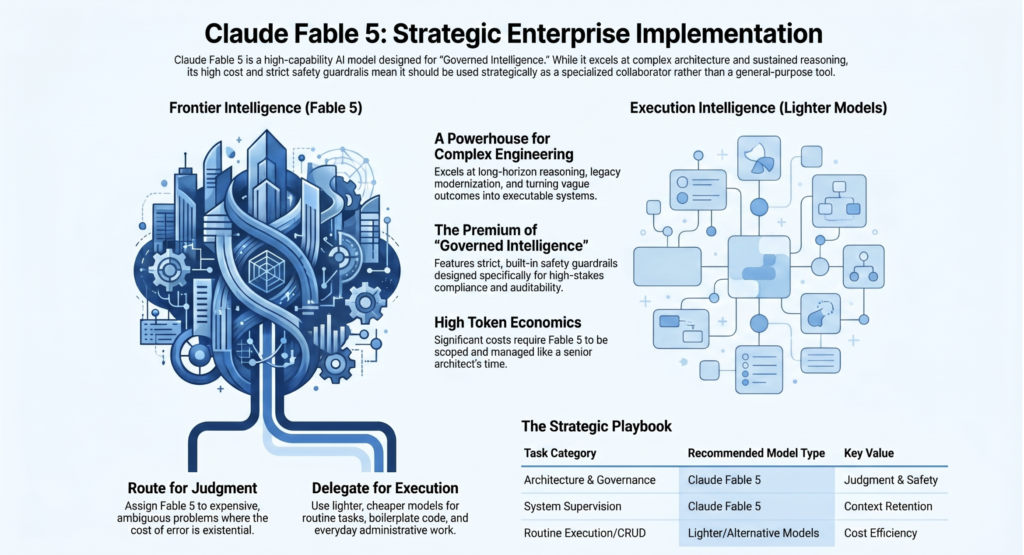
The token economics are significant. Long sessions burn fast. Used casually, it wastes money. Used deliberately, it has to be scoped like a senior architect’s time — which means hybrid orchestration is the right model. Fable 5 for strategy, architecture, and supervision. Lighter models for routine execution and boilerplate.
The premium is difficult to justify over GPT-5.5-class models or lighter Claude variants for everyday work. I would not pay Fable pricing to rewrite emails or generate basic CRUD. I will pay it when the problem is expensive, ambiguous, and consequential — and that is a useful filter to have.
The other friction is the control layer. Fable 5 ships with strict guardrails and safety routing that can interrupt workflows mid-session. In regulated environments, governance and auditability genuinely matter. But controls cannot become drag. Enterprise AI has to protect the business without slowing delivery to a crawl, and that balance is still being negotiated in practice.
The Ugly: Research Frustration, Jailbreak Noise, and Hype
The launch is already polarizing in ways worth naming directly.
For some users, Fable 5 feels powerful but disappointing because the safety layer is so visible. Researchers and advanced users are hitting refusals, blocked areas, and limits on what the full model will engage with. That frustration is real and legitimate.
At the same time, jailbreak attempts are already circulating across sensitive domains. That pattern proves the tension Anthropic is managing. The more capable these models become, the less relevant the question of whether they can do something becomes — and the more consequential the question of whether you can govern what they do. That is the actual enterprise battleground, and most reviews of Fable 5 are treating it as a footnote.
Vision is not flawless either. It performed better with screenshots than with raw files — which matters in real delivery environments where teams work inside messy specs, incomplete data, and half-broken legacy systems, not clean benchmark conditions.
So yes, Fable 5 is impressive. It is also expensive, constrained, occasionally frustrating, and probably overhyped in the directions that matter least.
My Take
For regulated enterprise work, the guardrails are not friction. They may be the product.
That is what most reviews are missing. The capability race was always going to run into the question every operator inside a regulated institution already understands — not whether the system can do the work, but whether you can prove you governed what it did. Fable 5 is the first model I have used where that question feels built into the product rather than added as an afterthought. That is a larger signal than any benchmark score.
I am not making it my daily driver. I am routing my hardest problems to it and keeping lighter models for everything else. That is the playbook now.
Cheap intelligence for execution. Frontier intelligence for judgment. Governed intelligence where the cost of being wrong is existential.
If you are running AI inside a regulated organization, I want to hear from you. Where did the guardrails protect you? Where did they get in the way? And where are you drawing the line between capability and control?
Keep Growing.
Gunjan